





1. Energy and power
Energy is measured in joules (\text{J}). Energy is transferred or transformed when a motor turns, a light shines or a resistor warms up. Power tells us how fast that happens. One watt is one joule per second:
Lifting a 100 g object by one metre near Earth’s surface increases its gravitational potential energy by about one joule. Lift it in one second and the average lifting power is about one watt. Take two seconds and the average power halves for the same energy. The mechanics appendix develops the example.
A power rating gives the power a manufacturer allows under specified conditions. A 0.25 W resistor does not have an internal limiter that stops it receiving more than 0.25 W.
2. Why volts multiplied by amperes give watts
Voltage tells us how much energy is transferred per unit of charge. A current tells us how much charge passes per second. Multiplying them gives energy per second:
For example, at 5 V each coulomb can transfer 5 J. If 0.05 C passes per second, the power is 5\times0.05=0.25\ \text{W}. The definition of charge in Lesson 1 explains the coulomb.
3. Three ways to find resistor power

Start with P=UI. If you know the current, replace U with RI. If you know the voltage, replace I with U/R:
Use the quantities you already have. Doubling the current through a fixed resistor quadruples its power. Doubling the voltage across the same resistor also quadruples its power.
4. The Joule effect
The resistor converts electrical energy into thermal energy. Its moving electrons transfer energy to the material. That heating is called the Joule effect. It can be useful in a heater. On a circuit board it can raise the temperature of adjacent parts or make a measurement drift.
5. Why the temperature can settle

When power is first applied, the resistor stores some of the energy and its temperature rises. As it warms, more heat transfers to its surroundings through the leads, the air and radiation. A steady temperature is reached if the heat leaves as fast as it is produced and the component remains intact.
To observe this without overloading the resistor, use a 100 Ω resistor rated for at least 0.5 W under the test conditions and a current-limited 5 V DC supply. Calculate about 0.25 W before switching on. Observe the temperature rise with a suitable thermometer. Switch off and allow the part to cool before handling it. Keep the overload example at the start on paper.
6. Choose a power rating as well as a resistance

A physically larger resistor often has more surface for heat transfer, although the material, leads and mounting also matter. Read the data sheet for the actual part. For a calculated 0.81 W, the teaching rule of allowing twice the calculated power calls for at least 1.62 W, so you might choose a 2 W part. The manufacturer’s temperature and mounting limits still apply. Lesson 6 shows how to use a derating curve, which gives the allowed power at different temperatures.
7. A brief pulse is different from continuous power
A short pulse may end before much heat reaches the outside of the part. Some resistors can therefore take more power for a pulse than they can continuously. The following figures are approximate readings from the single-pulse curves for three Vishay Beyschlag metal-film resistor sizes. Use the conditions and voltage limits in the data sheet for an actual design. Vishay document 28766, page 9
| Pulse duration | 0204, 0.4 W rated | 0207, 0.6 W rated | 0414, 1 W rated |
|---|---|---|---|
| 10–100 µs | 33 W | 73 W | 149 W |
| 1 ms | 22 W | 50 W | 99 W |
| 10 ms | 8.7 W | 21 W | 41 W |
| 100 ms | 3.2 W | 7.3 W | 14 W |
| 1 s | 1.1 W | 2.7 W | 5.4 W |
| 10 s | 0.50 W | 1.1 W | 2.2 W |
For the 0207, a 73 W pulse lasting 100 µs delivers 7.3 mJ. A 21 W pulse lasting 10 ms delivers 210 mJ. The maximum pulse energy is therefore not constant across durations. On a longer pulse the part has more time to transfer heat out. At very short durations the curve flattens, and the pulse voltage has its own limit.
One pulse or many
The same data sheet gives a separate curve for repetitive pulses. Approximate readings for the 0207 show the difference:
| Pulse duration | Single pulse | Repetitive pulses under the curve’s conditions |
|---|---|---|
| 10–100 µs | 73 W | 40 W |
| 1 ms | 50 W | 28 W |
| 10 ms | 21 W | 11 W |
| 10 s | 1.1 W | 0.63 W |
Closely spaced pulses can accumulate heat. Check the repetition conditions, the average power and the pulse voltage and power for the part you will actually use. A manufacturer’s curve can be based on a permitted change in resistance as well as physical survival. A different resistor with the same continuous rating can have very different pulse limits.
8. Where the energy goes
At 5 V across 100 Ω, the current is 50 mA and the power is 0.25 W. In 10 seconds that corresponds to 2.5 J. In 60 seconds it corresponds to 15 J. These figures are the total electrical energy converted during each interval. As the resistor heats, some energy leaves for its surroundings. At a steady temperature the energy keeps flowing with little further accumulation in the component.
9. Your turn
- A motor takes 2 A from a 12 V supply. What electrical power enters it?
- Calculate the power for 9 V across 100 Ω.
- What risks would arise if the resistor in question 2 were rated for 0.25 W? Use the teaching rule of twice the calculated power to choose a rating to check.
- How much energy is converted by a resistor dissipating 2 W for 30 s?
Answers
- P=12\times2=24\ \text{W}. This is the electrical input power. The useful mechanical output is smaller if the motor has losses.
- P=9^2/100=0.81\ \text{W}.
- 0.81/0.25=3.24. The part may overheat, drift or fail. Twice 0.81 W gives 1.62 W, so a 2 W part is a candidate once its mounting and temperature limits are checked.
- E=2\times30=60\ \text{J}.
Looking ahead — Power in alternating circuits
An ideal resistor converts the electrical energy it receives into heat. Capacitors and inductors can also store energy and return it later. In sinusoidal AC, active power is the average rate of net energy transfer, in watts. Reactive power describes the periodic exchange of energy, in var. Apparent power is the product of the RMS voltage and current, in volt-amperes. The RMS values are the effective voltage and current values used for comparison with DC heating.
Historical note — James Prescott Joule

Joule (1818–1889) wanted to find out how much heat an electric current produced. He passed current through a conductor in water and measured the temperature rise, then compared runs with different currents and resistances.
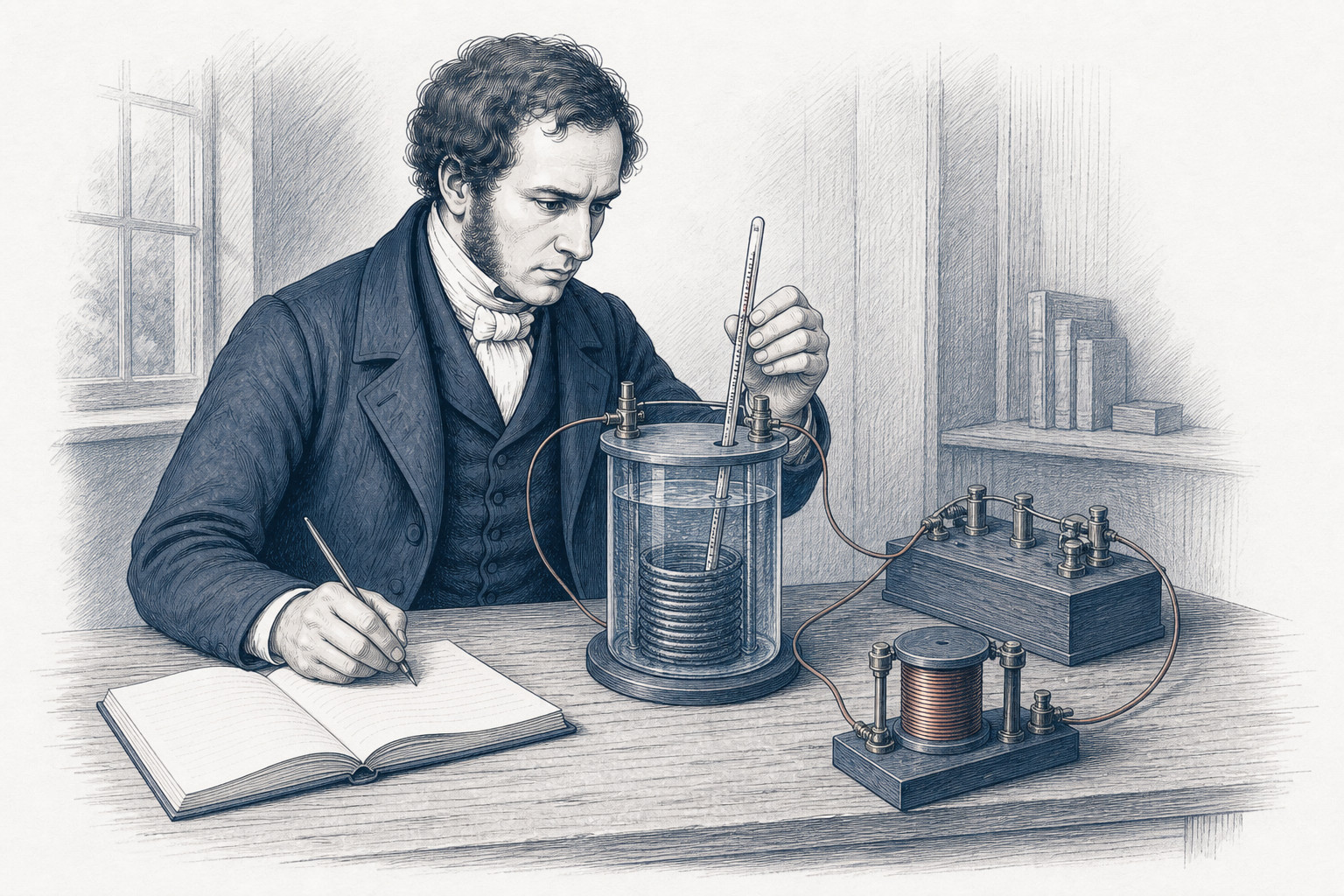
Visual reconstruction generated with AI for teaching purposes. It is not a historical archive document.
For the same duration and resistance, twice the current produces four times the heating energy. At a fixed current, a higher resistance produces more heat per second. At a fixed voltage, increasing the resistance instead lowers the current and the power. It matters which quantity is held steady.
Joule reported results to the Royal Society in 1840 and published a fuller account in 1841. Later experiments compared the mechanical work used to stir water with the heat produced. The joule is named after him. The relation 1\ \text{W}=1\ \text{J/s} ties those energy measurements to the power flowing into a resistor on our bench.
Previous lesson — Ohm’s law · Module plan · Next lesson — series and parallel
© Sébastien Debucquoi — All rights reserved.